

Wyn Hopkins, AI and the question we haven’t quite answered
By Hiran de Silva
There is a very pertinent point in Wyn Hopkins‘s discussion about AI-generated content.
As AI becomes increasingly human-like, it becomes increasingly difficult to distinguish between something produced by a human and something produced by AI. And Wyn raises an important ethical objection:
Pretending to be somebody you are not is deceitful.
I agree.
But that immediately raises another question.
Because every day, millions of us willingly take instructions from something that sounds remarkably like a human being — even though we know perfectly well that it isn’t one.
The Sat Nav Problem
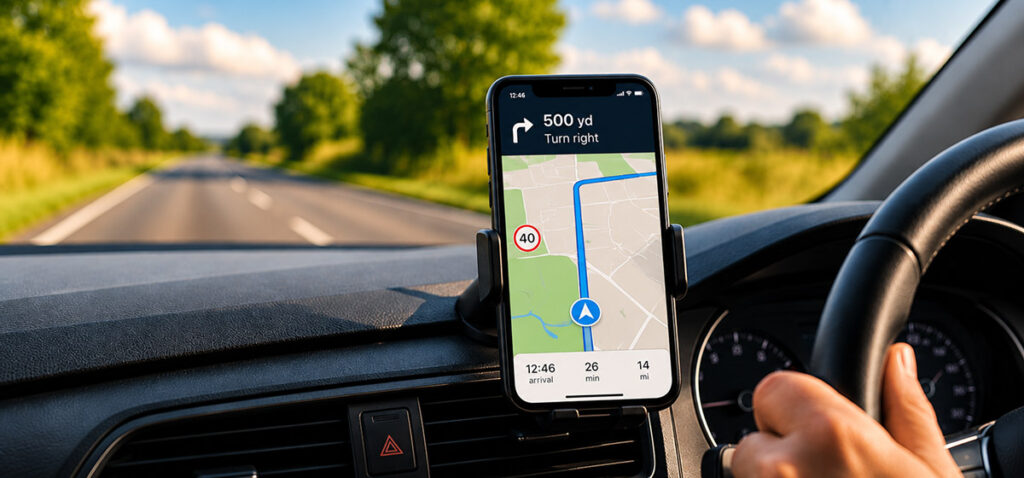
You get into your car.
You enter your destination.
A pleasant voice says:
Turn left at the next junction.
And you turn left.
You don’t stop the car and demand:
Who are you?
Why should I believe you?
Are you actually a human being?
Why are you pretending to be a person?
You don’t demand a disclosure statement before taking the next exit.
You simply follow the instructions.
And, interestingly, as consumers we generally regard a more natural, more human-sounding voice as an improvement.
So here is my question.
Why isn’t the sat nav deceitful?
If the problem is simply that a machine is speaking like a human being, then surely the sat nav should present precisely the same ethical problem.
Yet almost nobody regards it that way.
Why?
I think the answer takes us somewhere much more interesting than whether a voice is synthetic.
It takes us to trust.
Why We Trust the Sat Nav
Think about what sits behind that voice.
First, there is the territory.
The roads exist.
London is where London is.
The British Museum isn’t going to relocate itself overnight because somebody on LinkedIn has a different opinion.
The territory exists independently of the person — or machine — explaining it.
Second, there is the map.
The sat nav is not inventing the geography as it speaks. It is navigating an established environment.
Third, there is an algorithm working out a route through that environment.
Fourth, millions of people use these systems every day. Their operation is continually tested against reality.
And finally, we know what the sat nav is for.
There is no ambiguity about its role.
It is not trying to persuade you that it is an interesting person.
It is trying to get you from A to B.
That distinction becomes extremely important when we start talking about my use of AI avatars.
My Territory Already Exists
What am I actually using my AI avatars to explain?
At the foundation of much of my work is the client-server architecture.
This is hardly something I invented.
Its intellectual origins go back decades, but client-server computing became particularly important commercially during the late 1980s and early 1990s, as networked personal computers increasingly operated as clients to shared servers.
By 1993 IBM was describing client-server as a major new approach to business computing, and by 1994 there were executive guides devoted specifically to client-server architecture.
In other words, this isn’t Hiran’s interesting new theory about computers.
The territory already exists.
And that is important.
Because the analogy with the sat nav now becomes much clearer.
Excel Has Been Able to Travel This Road for Decades
Microsoft Office itself developed increasingly powerful ways of participating in this connected world.
Office 97 was released in January 1997 and Microsoft explicitly presented it as a major step towards connected, Internet and intranet-enabled working. Microsoft described it as integrating desktop applications with the Web and corporate networks. (Source)
The important point for my argument isn’t a particular Microsoft acronym or release date.
It is this:
Excel did not have to remain an isolated file sitting on somebody’s desktop.
Excel could participate in a wider architecture in which data was held centrally and multiple users and applications could interact with it.
That is the architecture I have spent much of my career exploiting.
And it leads directly to what I now call the Digital Librarian.
Now Look at the Two Maps
This is where my Tim, Ted, Tina and Tanya animation becomes important.
Put two diagrams side by side.
On one side is the familiar spreadsheet world.
Files pass between people.
One spreadsheet feeds another.
Copies proliferate.
Someone consolidates them.
Someone emails another version.
Another workbook extracts data from several others.
Then somebody creates another workbook to reconcile the results.
That is effectively a point-to-point architecture.
Now look at the alternative.
Tim, Ted, Tina and Tanya communicate through a common central source.
They GET what they need.
They PUT back what they are responsible for.
The data is centrally controlled.
The spreadsheets become clients.
The Digital Librarian becomes the hub.
That is hub-and-spoke.
Or, architecturally, client-server.
Once you see the two diagrams side by side, the difference is almost embarrassingly obvious.
And this is precisely where my sat-nav analogy becomes relevant.
My Avatar Isn’t Inventing the Destination
Suppose the CFO says:
I have 400 business units.
I need 100 budget holders to submit their budgets.
I need consolidation.
I need review.
I need auditability.
I need security.
I need version control.
I need management comments.
And I need to know exactly where we are at any point in the process.
That is the destination.
My explainer can now show the architecture available for getting there.
It can explain GET.
It can explain PUT.
It can explain the database.
It can explain the hub.
It can explain the spokes.
It can demonstrate the resulting process.
That is very much like teaching somebody that this is a road, this is a junction, this is how you turn left, this is how you turn right — and this is the route from where you are to where you said you wanted to go.
Why does the person explaining those things have to be human?
This Is Where AI Becomes Extremely Useful
I waffle.
Anyone who knows me will know that.
Give me an interesting subject and I can take several scenic routes before arriving at the destination.
AI doesn’t have to do that.
I can take my knowledge, demonstrations, experience and arguments and package them into a carefully structured explainer.
An AI avatar can present that explainer consistently.
It can illustrate it.
It can repeat it.
It can potentially present it in different languages.
It can make something I have spent decades discovering available to somebody on the other side of the world while I am asleep.
That doesn’t make the underlying proposition less true.
The avatar isn’t the evidence.
The evidence is the evidence.
The architecture exists.
The demonstrations work.
The business requirements can be stated.
The results can be tested.
And that brings us to what I think is the really uncomfortable part of this discussion.
What If the AI Avatar Is More Dependable Than the Human Influencer?
There is a tendency in social media to associate a human face with authenticity.
Human on camera: authentic.
AI avatar: potentially deceptive.
I don’t think that distinction survives serious examination.
Because a perfectly genuine human being can look directly into a camera and confidently teach something that is inappropriate for the business problem facing the viewer.
They aren’t necessarily lying.
They may sincerely believe what they are saying.
But sincerity and correctness are not the same thing.
And this matters enormously in Excel.
Take consolidation.
Take reconciliation.
Take using Excel as a database.
Take cascading dropdowns.
Take combining tables.
There are enormously popular tutorials explaining techniques for solving these problems inside individual spreadsheets.
Some have been watched millions of times.
The techniques themselves may be perfectly valid.
But introduce an enterprise collaborative requirement and something changes.
The question is no longer:
Can this technique work?
The question becomes:
Does this architecture get the organisation where it needs to go?
That is an entirely different question.
And Now We Turn Wyn’s Argument Around
Imagine my AI avatar explaining the two architectures to a CFO.
Here is point-to-point.
Here is hub-and-spoke.
Here are your requirements.
Here is what happens when 400 people participate.
Here is the data.
Here is the audit trail.
Here is the consolidation.
Here is the demonstration.
Now decide.
At that point the AI avatar may actually be telling the CFO:
Be careful about implementing what the human influencer on YouTube just showed your staff.
And suddenly our neat distinction between human authenticity and AI deception becomes much harder to maintain.
The human may be completely authentic.
The human may be charming.
The human may have hundreds of thousands of followers.
The human may have millions of views.
And the AI avatar may still be giving the CFO the more appropriate route.
Because authenticity of the speaker and validity of the route are two completely different things.
Back to the Sat Nav
And that takes us all the way back to the car.
The sat nav says:
Turn left.
Another person standing at the junction says:
No. Turn right.
Which one do you trust?
You don’t resolve that question by asking which one sounds more human.
You resolve it by asking:
Where am I trying to go?
That is really the foundation of my argument.
I am not claiming that AI-generated content should automatically be trusted.
Far from it.
I am saying that we need a much better test than:
Was this spoken by a human?
We should be asking:
What is the destination?
What is the map?
What evidence supports the route?
Can the result be demonstrated?
Can I test it?
And does it actually take me where I said I wanted to go?
Because that is ultimately what my explainers are trying to do.
I am laying out the map.
I am showing the two roads.
I am demonstrating where they lead.
And then I am asking the CFO, the finance professional, the Excel user — whoever is sitting in the driving seat:
Where do you want to go today?
If your destination is local, perhaps the local spreadsheet solution is exactly what you need.
But if your destination is an end-to-end collaborative enterprise process, then you may need a very different road.
And whether the voice telling you that is mine, Nathan’s, Simone’s or an AI-generated voice is ultimately secondary.
Don’t trust the face.
Don’t distrust the avatar.
Check the map.



Add comment