

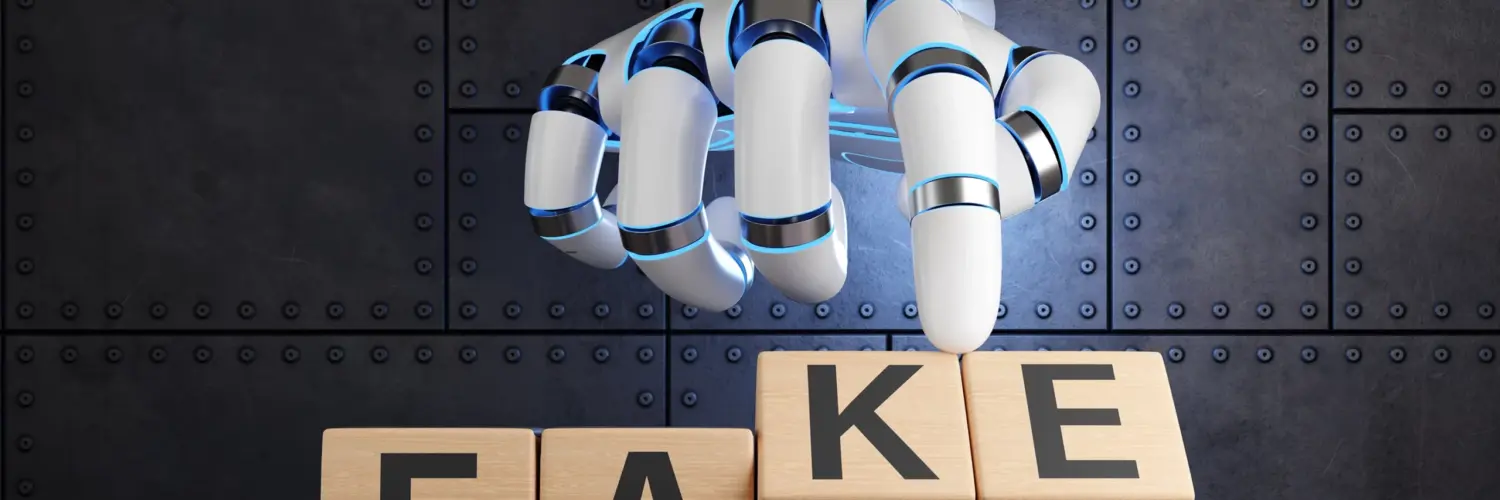
Part Two: Are We Really Being Deceived?
My previous article started with a distinction.
There is a profound difference between using AI to manufacture expertise you don’t possess and using AI to communicate expertise, knowledge or ideas you already possess.
But the discussion that prompted it continued.
And it raised another statement with which I completely agree:
Pretending to be something you’re not is deceitful.
Absolutely.
No argument from me.
But now we have to ask the much more difficult question.
What exactly do we mean by pretending?
Because if we’re not careful, we are going to confuse representation with deception.
And human civilisation has been happily using representation for thousands of years.
I’ve Been Pretending to Be Other People for Years
For many years, one of my passionate hobbies was musical theatre.
And whenever I walked onto a stage, I pretended to be somebody else.
That’s rather the point.
It’s called acting.
The audience knew I wasn’t actually that character.
I knew I wasn’t that character.
Nobody stormed out of the theatre shouting:
Fraud! That man is pretending to be somebody he’s not!
There was no deception because there was no false claim.
The medium was understood.
Now think about cinema.
Hundreds of people enter a dark room and stare at flashing patterns of light projected onto a large white surface.
Nobody sits there thinking:
What the hell am I doing? I’m staring at a wall.
Within seconds, the wall disappears.
We see people.
Places.
Stories.
Drama.
We laugh.
We cry.
We become frightened.
We become emotionally invested in events that aren’t happening, involving people who may be portraying people who never existed.
We have learned to transcend the physical mechanism and consume the meaning.
The medium disappears.
Your Friend Isn’t Inside Your Telephone
The telephone is an even simpler example.
A friend called me from an airport departure lounge this morning.
I picked up my phone and started talking to him.
I didn’t think:
This is ridiculous. I’m lying in bed talking to a piece of plastic.
Of course I was physically talking into a piece of plastic.
But that isn’t how I experienced it.
I was talking to my friend.
We have completely transcended the technology carrying the communication.
The same thing happened with recorded music.
If I turn on the radio and hear The Beatles, I don’t complain that The Beatles aren’t actually standing in the radio studio performing the song at that moment.
I understand what a recording is.
If I read Shakespeare, I don’t demand Shakespeare’s original handwritten manuscript before accepting the words as authentic Shakespeare.
The technology transports the work.
It doesn’t invalidate it.
So why are we suddenly applying a completely different philosophical standard to AI?
Perhaps We’re Simply in the Awkward Stage
We’ve been here before.
New technologies often arrive with a transitional period in which people remain psychologically attached to the previous medium.
I remember the early days of email.
You sent somebody an email.
And then you telephoned them.
I’ve sent you an email.
It sounds ridiculous now.
But people genuinely did it.
We hadn’t quite learned to trust the new medium on its own.
Early motor cars produced an even more absurd example. Britain once required a person to precede certain self-propelled vehicles carrying a red flag.
Think about that.
We had invented a machine to transport people without horses.
And then made somebody walk in front of it.
Technology had moved forward.
Our thinking hadn’t caught up.
Perhaps we’re doing something similar with AI.
Is This Really Me?
Here’s where the argument becomes rather wonderfully self-referential.
Let me explain how I created this article.
I was going about my day.
I had eaten breakfast.
I was enjoying an ice lolly on a warm British summer day.
And something I had read online had got me thinking.
So I picked up my phone and started talking.
And talking.
And talking.
I didn’t have a script.
I wasn’t reading something AI had written for me.
I was responding to an argument.
Sometimes these recordings last ten minutes.
Sometimes 20.
Sometimes considerably longer.
Sometimes I start talking about one subject and halfway through realise I’ve discovered another subject entirely.
It is stream-of-consciousness thinking.
It’s messy.
It’s repetitive.
I interrupt myself.
I change direction.
I lose words.
Speech recognition occasionally turns what I said into complete gobbledygook.
In other words:
It is extremely human.
And you really don’t want to read the raw transcript.
Enter AI
The recording is transcribed.
I then give that transcript to AI.
AI can infer words the transcription system misunderstood because it understands the context of what I’m discussing.
It removes repetition.
It identifies the argument.
It creates headings.
It turns 20 minutes of spoken waffle into something you can read in perhaps five minutes.
Then I listen to the result.
I challenge it.
I change things.
Sometimes I ask AI to critique my argument.
What might somebody object to?
Where have I overstated something?
What needs evidence?
Where could the reader misunderstand me?
And then I publish it.
So tell me:
Which part of that is inauthentic?
The thoughts are mine.
The examples are mine.
The argument is mine.
The experiences are mine.
The conclusion is mine.
AI has done something extremely useful.
It has made them easier for you to consume.
Why Should You Have to Suffer My Waffle?
This seems to me to be the question almost nobody asks.
Why should authenticity require inefficiency?
Suppose it takes me 40 minutes to explain something badly, with pauses, repetitions, false starts and diversions.
AI can help me communicate precisely the same idea clearly in six minutes.
Why is making you endure the 40-minute version somehow more authentic?
Indeed, isn’t that slightly disrespectful of your time?
The objective of communication should surely be to transfer an idea from one mind to another as accurately and efficiently as possible.
If technology improves that transfer, why would we deliberately make the communication worse simply to prove that a human being physically performed every stage?
The Four-Click Test
Here’s a practical example.
I want to create a short demonstration showing something about Excel that many users don’t realise is possible.
I want to show Excel creating a relational database.
Click.
I want to create a table in that database based on an Excel table.
Click.
I want to send data from Excel into it.
Click.
And then I want another spreadsheet to query that centrally held information and retrieve it.
Click.
Four clicks.
The purpose of the video is to demonstrate the architecture.
The database is real.
The table is real.
The data movement is real.
The query is real.
The Excel workbook is real.
You can reproduce it yourself.
Now suppose an AI voice explains what is happening while you watch the demonstration.
I have a question.
Why do you need my face?
What epistemological function does my face perform?
Does the database become more relational because you can see me?
Does the SQL execute more accurately?
Does Excel retrieve the data more reliably?
Does the demonstration become more true?
Of course not.
If my objective is to demonstrate something, then surely the demonstration itself is the evidence.
Proof Versus Performance
And this brings us to what I think is a far more important authenticity problem.
Suppose we have two videos.
Video A features a real human being.
Beautiful studio.
Excellent lighting.
Charismatic presenter.
Confident delivery.
The presenter makes a technical assertion.
But it cannot be demonstrated.
Video B uses an AI avatar.
An artificial voice.
No human presenter appears anywhere.
But it makes the opposite assertion and then proves it live on screen.
Which one is more authentic?
The human?
Or the evidence?
That’s not a trivial question.
Because we are currently in danger of giving an enormous authenticity bonus simply to the presence of a human face.
And social media has already demonstrated why that is dangerous.
Humans Can Manufacture Authority Too
This takes me back to the argument in Part One.
We are suddenly worried that AI can manufacture the appearance of authority.
But haven’t humans been manufacturing the appearance of authority on social media for years?
Studio lighting.
Camera quality.
Editing.
Graphics.
Music.
Charisma.
Confidence.
Follower counts.
View counts.
Personal branding.
All of these things can make someone appear authoritative.
None proves that what they’re saying is correct.
A real human being can look straight into a real camera and confidently say complete nonsense.
And an artificial voice can explain something completely correct while a reproducible demonstration proves every word.
Which should we trust?
Surely we should eventually arrive at the same standard we use everywhere else:
Evidence.
Perhaps the Camera Is the Distraction
This raises another uncomfortable possibility.
When somebody creates educational content, what exactly is the purpose?
Is it to explain something?
Or is it to be seen explaining something?
Those are not necessarily the same objective.
Social media has created an economy around personality.
That can be enormously useful. Great teachers have always used personality, humour and performance.
But personality can also disguise weak content.
A presenter can be engaging without being experienced.
Persuasive without being correct.
Popular without having professional responsibility for the situations about which they speak.
Which brings us back to the problem I discussed previously.
If millions of people watch solutions to individual spreadsheet problems, that proves enormous demand for those solutions.
It doesn’t prove that those solutions represent the architecture a CFO actually needs.
We can become exceptionally good at improving local spreadsheet processes while never questioning why the organisation has hundreds of disconnected local spreadsheet processes in the first place.
And no amount of human authenticity changes that.
The Human Says It. The Machine Proves It.
Imagine this experiment.
A recognised human expert appears on camera and tells you something about Excel.
Then an AI avatar appears and tells you the opposite.
Who should you believe?
Wrong question.
Ask both of them:
Show me.
Now the human demonstrates their claim.
The AI-presented video demonstrates its claim.
One demonstration works.
The other doesn’t.
At that moment, the question of whether the voice has vocal cords becomes almost comically irrelevant.
The evidence has settled the matter.
And perhaps that is where professional content eventually needs to go.
Away from:
Who said this?
Towards:
Can you prove this?
Authenticity After AI
I suspect future generations may find some of today’s arguments about AI rather quaint.
They may develop very different signals for authenticity.
They may care less about whether the voice was synthetic.
Less about whether the presenter physically stood in front of a camera.
Less about whether AI improved the grammar.
Instead they may ask better questions.
Where did the idea originate?
What evidence supports it?
Can it be reproduced?
Does the author understand it?
Can they defend it?
Does it work outside the demonstration?
What happens when it encounters reality?
Those seem to me to be far more useful measures of authenticity.
Because pretending to be something you’re not is deceitful.
On that point I completely agree.
But using technology to communicate what you genuinely know isn’t pretending.
A telephone isn’t pretending to be your friend.
A recording isn’t pretending to be The Beatles.
A printed book isn’t pretending to be Shakespeare.
And an AI voice explaining my reproducible demonstration isn’t pretending that the demonstration happened.
The demonstration did happen.
Medium or Message?
Perhaps, then, we need to grow out of our fascination with the mechanism.
We don’t judge a telephone conversation by examining the plastic.
We don’t judge Shakespeare by inspecting the printing press.
We don’t judge a Beatles recording by asking whether John Lennon is physically inside the radio.
And perhaps we shouldn’t judge professional knowledge primarily by asking whether every word was physically typed, spoken or performed by the person whose ideas are being communicated.
Ask instead:
Is it their idea?
Do they understand it?
Can they defend it?
And, wherever possible:
Can they prove it?
Because there is something wonderfully absurd about where we may otherwise end up.
A charismatic human being, beautifully lit, confidently explaining something that doesn’t work…
will be considered authentic.
While an artificial voice showing you something that demonstrably does work…
will be considered fake.
If that’s our definition of authenticity, perhaps AI isn’t the thing we need to worry about.
Perhaps our definition is.


Add comment