


The short answer
The boiled egg story is almost certainly allegorical, not a documented historical event — but it survives because it captures a profound truth about innovation.
The story (as commonly told)
After returning from the New World, Christopher Columbus is said to have been challenged by Spanish nobles who claimed:
“Anyone could have discovered the New World by sailing west.”
Columbus responds by asking them to make an egg stand on its end.
They fail.
He gently taps the egg, flattening one end, and it stands.
His point:
once someone shows the way, it looks obvious.
The historical reality
- There is no contemporary account of this episode involving Columbus himself.
- The earliest known version appears decades later, most notably in a 1550s account by Girolamo Benzoni, an Italian historian writing long after Columbus’s death.
- Even more telling: the same story exists earlier, told about Filippo Brunelleschi, the architect of Florence’s dome — with the same egg trick.
This strongly suggests:
- The story is borrowed, recycled, and attached to famous innovators.
- It functions as a parable, not reportage.
Verdict
✔ Not historically verifiable
✔ Almost certainly allegorical
✔ Enduring because it explains a real cognitive phenomenon
And that phenomenon leads us directly to…
2. The Black Swan Event: what it really means
Where the term comes from
The modern concept was popularised by Nassim Nicholas Taleb, but the idea is far older.
For centuries in Europe:
- All observed swans were white
- Therefore, “all swans are white” was treated as fact
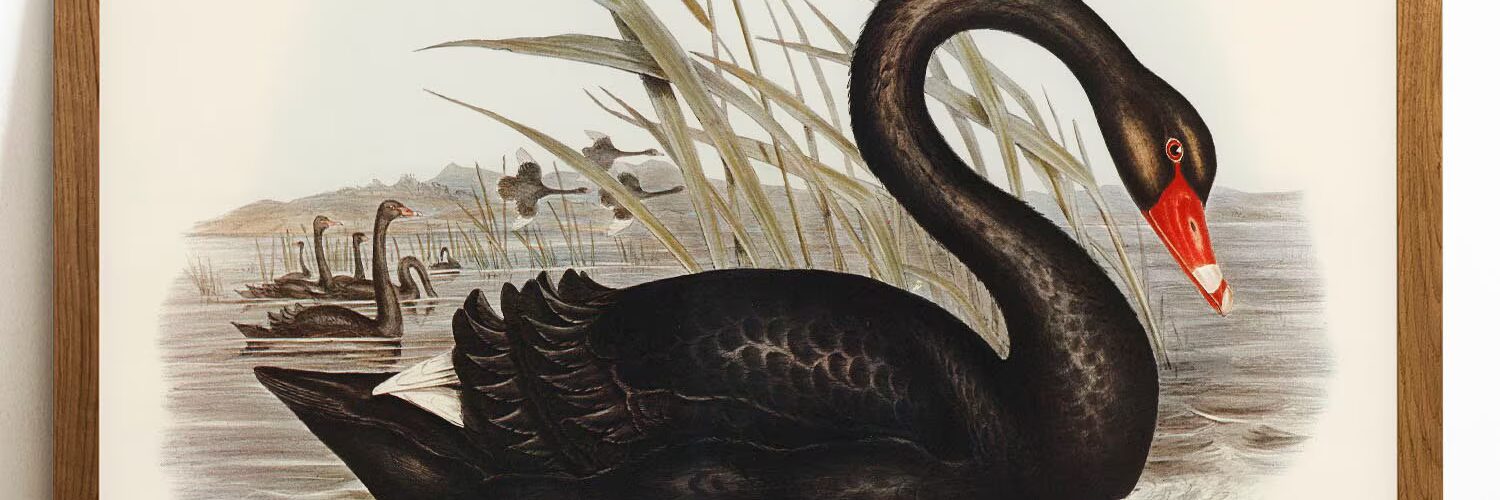
Then black swans were discovered in Australia.
One observation didn’t just add information —
it destroyed an assumption.
What defines a Black Swan Event
A Black Swan has three properties:
- It is outside prior expectation
Nothing in the existing mental model predicts it. - It has massive impact
It changes systems, not just outcomes. - It is retrospectively rationalised
After it happens, people say: “Of course — it was obvious.”
This third trait is the most dangerous.
3. Why Columbus, the egg, and Black Swans are the same story
The Columbus egg story — true or not — survives because it dramatizes a brutal truth:
Human beings confuse inevitability with obviousness.
Before the act:
- “Impossible”
- “Unthinkable”
- “Unnecessary”
- “No one does that”
After the act:
- “Trivial”
- “Anyone could have done it”
- “Why didn’t we do this years ago?”
This is post-hoc certainty — the illusion that understanding after the fact equals foresight before it.
The psychological trick
Black Swan events don’t just surprise us —
they rewrite the story of the past.
Once the path exists:
- The risk disappears
- The uncertainty vanishes
- The courage required is forgotten
And the innovator is quietly downgraded from:
“visionary”
to
“lucky person who did something obvious”
4. The deeper lesson (and why this matters)
Black Swan events reveal something uncomfortable:
Our models of the world are far narrower than reality itself.
They expose:
- Hidden assumptions
- False ceilings
- Social consensus masquerading as truth
- Expertise trapped inside yesterday’s constraints
And they explain why:
- True breakthroughs are resisted
- Pioneers are mocked before they’re copied
- Transformative ideas are dismissed as “impractical” until they work
Only after the egg stands upright does the table agree it could.
In one line
The Columbus egg may be a myth —
but the human behaviour it describes is absolutely real.




Add comment